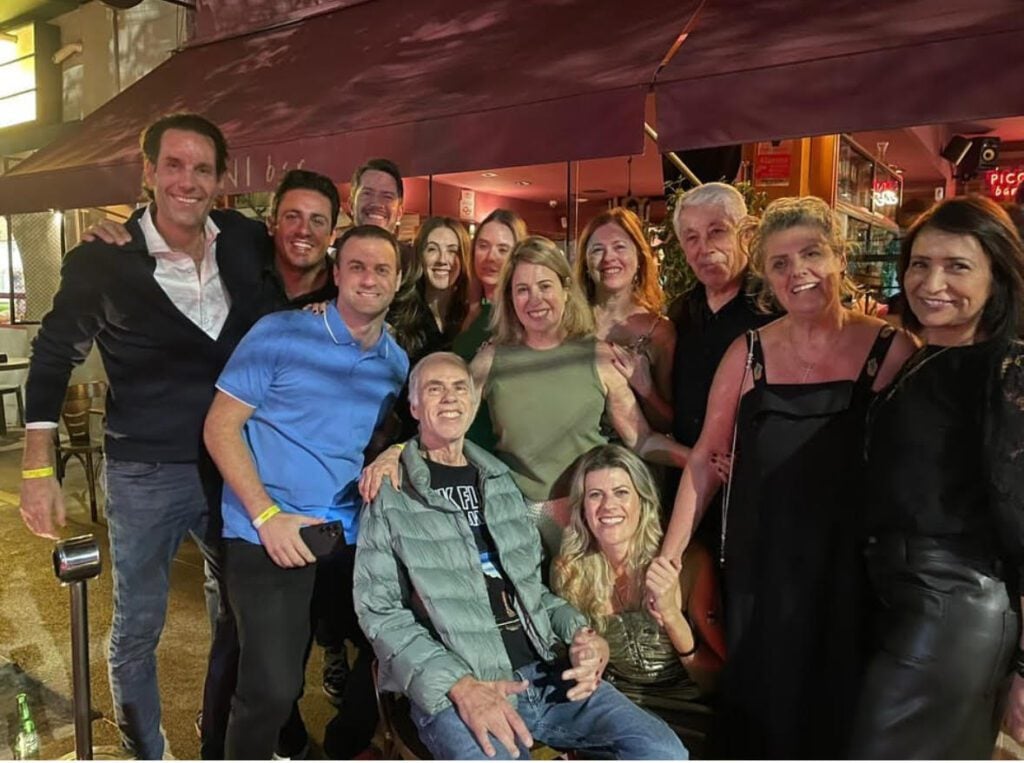
When Raquel Pozzani was introduced to Target ALS through a mutual connection, it was for a reason no family wishes to face: her father, Valdir, had been diagnosed with ALS. Within two years, his health declined rapidly, leaving him bedridden.
For Raquel, who shares a uniquely close bond with her father, the impact was devastating. “It’s like being buried alive,” she said. “Unbelievable and sometimes unbearable.”
Before ALS entered their lives, Valdir was the picture of health: an active cyclist, a man who never spent time in hospitals. To watch such vitality transform so quickly into fragility left the family reeling. But amid the grief, Raquel and her family have discovered resilience, unity, and unexpected beauty.
Living with ALS: Pain, Faith, and Small Victories
Raquel describes their journey as one filled with pain but also courage, faith, and perseverance. “Life is always worth living, despite all you’re facing,” she reflected. Even when her father resisted a tracheostomy surgery, she reminded him of recent FDA approvals for ALS therapies, urging him to hold on a little longer.
The family now celebrates moments once taken for granted. Despite his condition, Valdir insisted on attending Raquel’s birthday and other family events. “It’s a sign of loyalty,” she said. “Look, I’m here for you. I’m in poor condition, but I’m still here.”
The Power of Connection
ALS has brought the Pozzani family closer together and revealed the depth of love from their wider community. Friends and former colleagues regularly visit Valdir, offering strength and comfort.
“I never saw my dad cry before,” Raquel shared. “But he cried so much when he saw how many people showed up for him. Life surprises you, even people you thought you’d never see again came to show their love.”
This sense of community extends beyond family and friends. When Raquel attended the Target ALS Annual Meeting in Boston, she was inspired by the scientists working urgently toward new treatments. “Every minute invested is so important,” she said.
Hard Truths and Lessons for Families
Raquel speaks honestly about the challenges families face: the emotional weight, the need for constant adaptation, and the financial strain of care. In Brazil, where her family lives, finding skilled caregivers and accessing treatments is especially difficult. The family even had to pursue legal action against their insurance provider to secure support.
Still, she encourages those going through something similar to notice the light that still exists. “Despite everything, there is space for gratitude and love. You learn to live in the present. You value every gesture. Even in the hardest moments, it’s possible to find beauty.”
A Call to Scientists and Beyond
Raquel is determined to contribute beyond her own family’s journey. She is working to connect Target ALS with top Brazilian universities to open doors for new research and clinical trials.
Her message to the scientific community is clear and urgent: “Keep going. Entire lives depend on this dedication.”
Her words reflect what so many families touched by ALS feel: deep admiration for the scientists and caregivers fighting this disease, paired with an urgent plea for progress.
Why We Share Stories
At Target ALS, we believe that stories like Raquel’s remind us why our work matters. Every dataset, every discovery, every collaboration brings us closer to treatments. Families like the Pozzanis are holding on to hope, and they deserve a future where Everyone Lives.
For years, Howard Levine’s professional life centered on exploring how digital biomarkers could change the way we detect and monitor ALS. His work focused on harnessing at-home health data collection and monitoring technologies such as speech recordings, respiratory and motor skills assessments, and wearable sensors., to shorten the path to diagnosis, make participation in studies easier, and ultimately generate richer data to advance science.
Then ALS touched his family.
“I’ve spent the past five years working on ALS, and now my mother-in-law has been diagnosed,” Howard shared. “It’s suddenly taking on an extremely personal meaning for me. My wife said, ‘How random is it that this has been your work for years, and now it’s in our family?’ I’m still in shock. There are no words.”
Howard’s story is one of dual perspectives: the researcher focused on data and solutions, and the caregiver trying to support a loved one through an unforgiving disease. That intersection has sharpened both his sense of urgency and his belief in the importance of bridging science and the patient experience.
A Background in Healthcare
Howard entered the ALS field after years of working with healthcare startups, and pharmaceutical companies. The benefits of digital tools drew him in; technology which captures real-world patient data and monitors disease progression from home, as well as reducing trips to physician offices. sparked his interest in helping to advance cures. “I always hoped we could develop a digital biomarker to help detect ALS sooner,” he explained. “It can take more than a year to get diagnosed. That’s precious time lost, time when patients could have been on treatment.”
When the Professional Becomes Personal
In July of 2025, Howard’s mother-in-law was diagnosed. Her doctor raised concerns on the linked her case to environmental exposures in her community, a reminder of the complex, and still poorly understood, factors that may contribute to ALS.
“It motivates me to keep working in this field,” Howard said. “But it’s also deeply emotional. I feel helpless at times. I do what I can, sharing resources, supporting my wife as she steps into a caregiver role. But the truth is, ALS remains such a mystery. And now it’s our reality.”
What People Need to Know About Sporadic ALS
Howard emphasized one point above all: awareness of how ALS emerges and how crucial early diagnosis can be.
“Many people don’t realize ALS is mostly sporadic, it can affect families with no prior history,” he said. “And even some doctors struggle to diagnose it correctly. Anyone with neurological symptoms needs to seek expert evaluation quickly. The sooner you know, the sooner you can start treatment and live as fully as possible.”
Beyond diagnosis delays, Howard pointed to systemic gaps like insurance barriers and the need for stronger collaboration between researchers and patient families.
“Integrating the voice of the person with ALS may not directly deliver a cure, but it’s vital,” he said. “It helps ensure research reflects the realities of life with ALS. And that perspective can only help.”
A Message to Researchers
Howard’s closing words were directed at the scientific community working tirelessly in labs around the world:
“Maintain a sense of urgency. This work is difficult, expensive, and filled with setbacks. But stay optimistic and driven. Every experiment is a chance to move closer to a cure. Patients and families need you to keep going.”
For Howard, the convergence of his professional expertise and personal loss has reinforced both the heartbreak and the hope embedded in ALS research. His journey is a reminder of why urgency, inclusion, and relentless innovation matter, not just in theory, but in the lives of families everywhere.